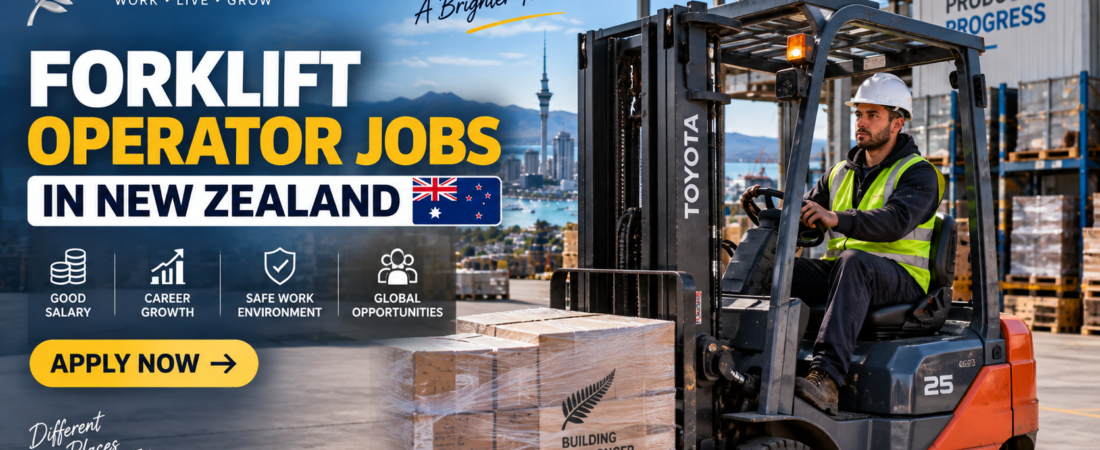
New Zealand offers employment opportunities for experienced Forklift Operators across warehouses, distribution centres, manufacturing facilities, ports, logistics companies, construction sites and industrial businesses.
Forklift Operators play an important role in moving, loading, unloading and storing materials safely. The job requires practical skills, attention to safety and the ability to operate forklift equipment efficiently in busy work environments.
For international workers, New Zealand can also offer opportunities through employer-supported work visas where the job and employer meet the applicable immigration requirements.
Current salary data shows that Forklift Operators in New Zealand can earn competitive hourly wages. Indeed’s September 2026 salary data reports an average base salary of approximately NZD $27.39 per hour, while reported salaries range from around NZD $23.95 to $31.76 per hour depending on experience, location and employer.
Forklift Operator Jobs in New Zealand – Quick Overview
| Job Detail | Information |
|---|---|
| Job Title | Forklift Operator / Forklift Driver |
| Location | New Zealand |
| Job Type | Full-Time, Part-Time or Contract |
| Industry | Warehousing, Logistics, Manufacturing, Construction & Distribution |
| Experience | Entry-level to experienced |
| Qualification | Forklift Operator Certificate generally required by employers |
| Licence | F endorsement required when driving a forklift on a road |
| Average Pay | Around NZD $27.39 per hour |
| Typical Reported Range | Approximately NZD $23.95–$31.76 per hour |
| Work Environment | Warehouses, factories, yards, construction and distribution centres |
Salary, working hours and benefits vary between employers and locations.
What Does a Forklift Operator Do?
A Forklift Operator is responsible for safely operating a forklift or industrial truck to move materials, products and equipment.
Forklift operators can work in warehouses, factories, distribution centres, construction sites and other industrial environments.
Typical responsibilities include:
- Operating forklifts safely
- Loading and unloading trucks
- Moving pallets
- Stacking goods
- Transporting materials around warehouses
- Loading products into storage areas
- Checking goods for damage
- Securing loads
- Moving heavy equipment
- Maintaining safe working areas
- Following workplace safety procedures
- Performing basic equipment checks
- Communicating with warehouse and logistics teams
New Zealand’s official career information describes forklift operators as workers who use forklifts or industrial trucks to move heavy materials around warehouses, factories, construction sites and similar workplaces.
Forklift Operator Responsibilities in New Zealand
1. Loading and Unloading
One of the main responsibilities is loading and unloading goods from trucks, containers and storage areas.
Operators must position the forklift correctly and make sure loads are stable before moving them.
2. Moving Materials
Forklifts are used to move materials around warehouses, factories and industrial sites.
Operators may transport:
- Pallets
- Boxes
- Machinery
- Building materials
- Raw materials
- Finished products
- Industrial equipment
3. Stacking and Storage
Forklift operators may place products on warehouse racks or designated storage areas.
This requires:
- Accurate forklift control
- Good visibility
- Careful positioning
- Awareness of surrounding workers
- Understanding of load limits
4. Checking Loads
Before moving a load, operators should check that it is stable and suitable for transportation.
They may also inspect products for visible damage and report issues to supervisors.
5. Workplace Communication
Forklift operators frequently work with:
- Warehouse supervisors
- Logistics teams
- Truck drivers
- Store workers
- Production staff
- Dispatch teams
Clear communication is important, particularly in busy warehouses where pedestrians and forklifts operate in the same area.
Types of Forklift Jobs in New Zealand
There are several types of forklift-related jobs available depending on the industry and equipment.
Warehouse Forklift Operator
Warehouse operators generally move pallets and products between receiving, storage and dispatch areas.
Typical duties include:
- Pallet movement
- Rack storage
- Truck loading
- Truck unloading
- Inventory support
- Warehouse housekeeping
Reach Truck Operator
Reach truck operators work primarily in warehouses with high storage racks.
Experience with reach trucks can be valuable for logistics and distribution jobs.
Counterbalance Forklift Operator
Counterbalance forklifts are commonly used for loading, unloading and general material handling.
Operators may work in:
- Warehouses
- Manufacturing
- Timber yards
- Construction
- Distribution centres
Container Forklift Operator
Some industrial and logistics businesses use heavy forklifts to move large loads and containers.
These positions may require additional experience and specific equipment knowledge.
Yard Forklift Operator
Yard operators work outside or in large industrial yards.
They may handle:
- Timber
- Building products
- Machinery
- Pallets
- Construction materials
Because these environments can be busy and exposed to weather, operators need strong situational awareness.
Forklift Operator Salary in New Zealand
Forklift Operator salaries vary depending on:
- Experience
- Location
- Forklift type
- Industry
- Shift pattern
- Employer
- Overtime
- Additional licences and skills
According to Indeed’s New Zealand salary data updated on 7 September 2026, the average base salary for a Forklift Operator is approximately NZD $27.39 per hour.
The reported salary range is approximately:
NZD $23.95–$31.76 per hour
Some current job advertisements also show rates such as:
- NZD $26.50–$30.00 per hour
- NZD $27.76–$30.00 per hour
- Higher rates for experienced or specialised operators
The New Zealand adult minimum wage is NZD $23.95 per hour from 1 April 2026, before tax.
These figures are indicative and actual pay can vary significantly between jobs.
Approximate Annual Earnings
For a full-time employee working 40 hours per week, hourly pay can translate into approximately:
| Hourly Pay | Approx. Annual Gross Pay* |
|---|---|
| NZD $24/hour | NZD $49,920 |
| NZD $27/hour | NZD $56,160 |
| NZD $30/hour | NZD $62,400 |
| NZD $32/hour | NZD $66,560 |
*Approximate gross figures based on 40 hours per week before tax and excluding overtime, allowances and other benefits.
Actual annual earnings depend on working hours, holidays, overtime and the employment agreement.
Forklift Operator Qualification Requirements
A forklift operator generally needs appropriate training before operating workplace equipment.
New Zealand career guidance states that forklift operators need a Forklift Operator Certificate, and that a driver licence with the appropriate special-type vehicle endorsement is required in relevant circumstances.
Employers may also require:
- Previous forklift experience
- Workplace safety training
- Hazard awareness
- Manual handling knowledge
- Good communication skills
- Physical fitness
- Ability to work shifts
- Experience with specific forklift types
Additional training can improve employment opportunities.
What Is an F Endorsement in New Zealand?
The F endorsement is a special endorsement on a New Zealand driver licence for driving forklifts.
According to NZ Transport Agency Waka Kotahi, if you drive a forklift on a road, you must have an F endorsement on your driver licence.
The appropriate driver licence class also depends on the loaded weight of the forklift.
A Class 1 licence with an F endorsement covers forklifts up to 18,000 kg loaded, while a Class 2 licence with an F endorsement covers forklifts over 18,000 kg loaded.
NZTA also notes that the definition of a road can be broad and can include places such as yards or other areas to which the public has access.
How to Get a Forklift F Endorsement
To obtain an F endorsement, an applicant needs to complete an approved course covering specialist knowledge and skills for safely driving a forklift on the road.
NZTA states that applicants must provide evidence of successfully completing an approved forklift endorsement course.
The forklift endorsement course is associated with NZQA Unit Standard 18496.
After completing the required course, the applicant can apply for the endorsement through a driver licensing agent.
It is important to understand that an F endorsement relates to driver licensing requirements. Employers may also require workplace-specific forklift training and health and safety training.
Can Overseas Forklift Experience Be Recognised?
International workers with forklift experience should keep detailed evidence of their previous employment and training.
NZTA notes that overseas experience may be recognised for special-type vehicle operators and advises applicants to contact the agency regarding recognition of overseas experience.
However, employers can have their own requirements for forklift certification and workplace training.
For overseas applicants, it is therefore useful to have:
- Forklift certificates
- Training records
- Employment certificates
- Experience letters
- Payslips
- Licence documents
- Equipment experience records
Skills Required for Forklift Operator Jobs
1. Forklift Operating Skills
Operators should be comfortable controlling the forklift accurately in confined and busy environments.
2. Load Handling
Workers need to understand:
- Load stability
- Weight limits
- Fork positioning
- Pallet condition
- Safe lifting
- Safe stacking
3. Safety Awareness
Safety is one of the most important aspects of forklift operation.
Operators need to be aware of:
- Pedestrians
- Other vehicles
- Blind spots
- Warehouse racks
- Loading docks
- Uneven surfaces
- Overhead obstacles
4. Concentration
Forklift operators need to remain focused throughout their shifts because warehouses and industrial sites can contain multiple moving vehicles and pedestrians.
5. Communication
Operators need to communicate with supervisors and other workers, particularly when moving loads in busy areas.
6. Physical Fitness
Although the forklift performs the heavy lifting, operators may still need to climb into equipment, inspect loads and perform physical tasks around the workplace.
Forklift Safety in New Zealand
Forklift operation is safety-critical work.
Employers and workers need to manage risks associated with:
- Moving vehicles
- Pedestrians
- Falling loads
- Overloaded equipment
- Poor visibility
- Loading docks
- Racking systems
- Uneven surfaces
- Mechanical faults
Operators should follow workplace procedures and never operate equipment beyond its rated capacity.
Before beginning work, operators may need to conduct checks of:
- Tyres
- Forks
- Mast
- Hydraulic systems
- Brakes
- Steering
- Warning systems
- Lights
- Seat belts
- Controls
Any significant defect should be reported before the equipment is used.
Work Environment for Forklift Operators
Forklift Operators can work in a variety of environments.
Warehouses
Warehouses are one of the most common workplaces.
Operators may move products between receiving, storage and dispatch areas.
Manufacturing Facilities
Manufacturing companies use forklifts to move raw materials and finished products.
Distribution Centres
Large distribution centres can operate forklifts throughout the day and night, creating opportunities for shift workers.
Construction Sites
Forklifts can be used to move building materials and equipment.
Timber and Industrial Yards
Outdoor forklift operators may handle timber, machinery and other large materials.
Working Hours for Forklift Operators
Forklift Operator jobs can involve different shift patterns.
Depending on the employer, workers may work:
- Day shifts
- Evening shifts
- Night shifts
- Weekend shifts
- Rotating shifts
- Overtime
New Zealand’s official career information notes that forklift operators usually work regular business hours but may also work evenings, weekends and overtime.
Shift-based roles may sometimes provide additional allowances or higher hourly rates, depending on the employment agreement.
Forklift Operator Jobs for Foreign Workers
International workers may be able to work as Forklift Operators in New Zealand if they meet the requirements of an appropriate visa.
One important pathway is the Accredited Employer Work Visa (AEWV).
The AEWV requires a full-time job offer from an accredited employer and an approved job check for the position.
The job must generally offer at least 30 hours of work per week.
Immigration New Zealand currently states that applicants generally need to meet the required skill criteria through relevant work experience or a qualifying qualification, along with other visa requirements.
Accredited Employer Work Visa for Forklift Operators
The AEWV process generally involves three stages:
1. Employer Accreditation
The employer must be accredited by Immigration New Zealand.
2. Job Check
The employer must have an approved job check for the position where required.
3. Worker Visa Application
After receiving the required job offer and supporting information, the worker can apply for the AEWV.
Immigration New Zealand states that the AEWV can allow an eligible worker to stay in New Zealand for up to five years, depending on the job, skill level, pay and other circumstances.
For some lower-skilled roles, the maximum continuous stay can be shorter.
Applicants should always check the current rules for their specific occupation before applying.
Forklift Driver and AEWV Skill Requirements
Immigration New Zealand uses occupation classifications such as ANZSCO and the National Occupation List (NOL) when assessing AEWV applications.
The current immigration framework identifies Forklift Driver under ANZSCO code 721311 in relevant classification material.
The exact skill level and visa requirements depend on how the role is classified and the circumstances of the job.
For an AEWV, applicants should be prepared to provide evidence of their work experience and qualifications where required.
A CV by itself is not sufficient evidence of work experience. Immigration New Zealand may accept supporting evidence such as:
- Employment certificates
- Payslips
- Tax records
- Employer references supported by other employment evidence
English Requirements
English requirements depend on the occupation’s skill level and visa circumstances.
Immigration New Zealand states that applicants whose AEWV job is classified at ANZSCO or NOL skill level 3 to 5 generally need to demonstrate that they can speak and understand English, subject to applicable exemptions.
Therefore, applicants should check the exact classification of their Forklift Operator position before assuming that an English test is or is not required.
How to Apply for Forklift Operator Jobs in New Zealand
A strong CV is important when applying for forklift positions.
Your CV should include:
Personal Information
- Full name
- Phone number
- Email address
- Current location
Work Experience
Mention:
- Company name
- Position
- Employment dates
- Forklift experience
- Main duties
- Types of workplaces
Forklift Experience
Clearly mention the equipment you have operated, such as:
- Counterbalance forklift
- Reach truck
- Electric forklift
- Diesel forklift
- High-reach forklift
- Warehouse forklift
Certifications
Include:
- Forklift Operator Certificate
- F endorsement, if applicable
- Health and safety training
- Other relevant licences
Additional Skills
Mention:
- Warehouse management
- Inventory handling
- Loading/unloading
- Pallet handling
- Dispatch
- Receiving
- Manual handling
- Radio communication
Documents to Prepare
International applicants should keep copies of relevant documents.
These can include:
- Passport
- Updated CV
- Forklift certificate
- Driver licence
- F endorsement documents, where applicable
- Employment certificates
- Experience letters
- Payslips
- Training certificates
- Educational qualifications
If applying for an AEWV, applicants should maintain strong documentary evidence of their work experience because Immigration New Zealand may require evidence beyond a CV.
Where to Find Forklift Operator Jobs in New Zealand
Job seekers can search for current vacancies through established New Zealand employment websites.
Popular platforms include:
- SEEK New Zealand
- Trade Me Jobs
- Indeed New Zealand
- Company career pages
- Recruitment agencies
When searching, use keywords such as:
Forklift Operator, Forklift Driver, Reach Truck Operator, Warehouse Forklift Operator, Counterbalance Operator, Storeperson Forklift, Logistics Forklift Operator and Distribution Centre Forklift Operator.
Using multiple search terms can help identify a wider range of suitable vacancies.
How to Improve Your Chances of Getting a Forklift Job
Highlight Your Forklift Experience
Mention exactly how many years you have operated forklifts.
List the Equipment You Know
Employers may be looking for experience with a particular type of forklift.
Keep Your Certifications Current
Include relevant training and certificates in your CV.
Mention Shift Availability
If you can work night shifts, weekends or rotating shifts, mention it where appropriate.
Highlight Warehouse Experience
Experience with receiving, dispatch, inventory and loading can strengthen your application.
Maintain a Clean Safety Record
Safety is extremely important in forklift operations, so employers may value workers with a strong workplace safety record.
Career Growth for Forklift Operators
Forklift operation can be the beginning of a broader career in logistics, warehousing and industrial operations.
A possible career path is:
Warehouse Worker → Forklift Operator → Senior Forklift Operator → Warehouse Team Leader → Warehouse Supervisor → Logistics Coordinator
Workers can also develop skills in:
- Inventory management
- Dispatch
- Warehouse systems
- Supply chain operations
- Heavy machinery
- Logistics coordination
Additional licences and training can increase career opportunities.
Benefits of Working as a Forklift Operator in New Zealand
Depending on the employer and employment agreement, workers may receive:
- Competitive hourly pay
- Overtime opportunities
- Shift allowances
- Annual leave
- Sick leave
- KiwiSaver contributions where applicable
- Workplace training
- PPE
- Long-term employment opportunities
- Career progression
Benefits differ between employers, so applicants should carefully review the employment agreement.
Important Advice for Overseas Job Seekers
International applicants should be careful when dealing with recruitment agents or people promising New Zealand jobs.
Immigration New Zealand specifically warns that job-offer scams are common in India and South Asia.
For an AEWV, New Zealand employers or agents cannot charge workers recruitment costs. Applicants should never pay an employer or recruiter simply to obtain a job offer.
Before accepting an overseas position, verify:
- Employer name
- Employer accreditation
- Job title
- Job location
- Salary
- Working hours
- Employment agreement
- Visa conditions
- Accommodation
- Transport
- Overtime arrangements
You can use Immigration New Zealand’s official Accredited Employer List to check whether an employer is currently accredited.
Final Words
Forklift Operator jobs in New Zealand offer opportunities across warehousing, logistics, manufacturing, construction and industrial sectors. The role is suitable for workers who have practical equipment-handling skills, good safety awareness and the ability to work efficiently in busy environments.
Current salary data shows an average Forklift Operator base salary of approximately NZD $27.39 per hour, while reported pay ranges from around NZD $23.95 to $31.76 per hour. Experienced operators with additional skills, licences or specialised equipment experience may have access to higher-paying opportunities.
For international workers, the Accredited Employer Work Visa can provide a potential pathway to work in New Zealand when the employer, job and applicant meet the relevant requirements.
Before accepting any overseas job, always verify the employer, employment agreement, salary, visa requirements and forklift certification requirements through official New Zealand sources.